Today’s readings included…

Ghosts of Gemini

Ghosts of Gemini

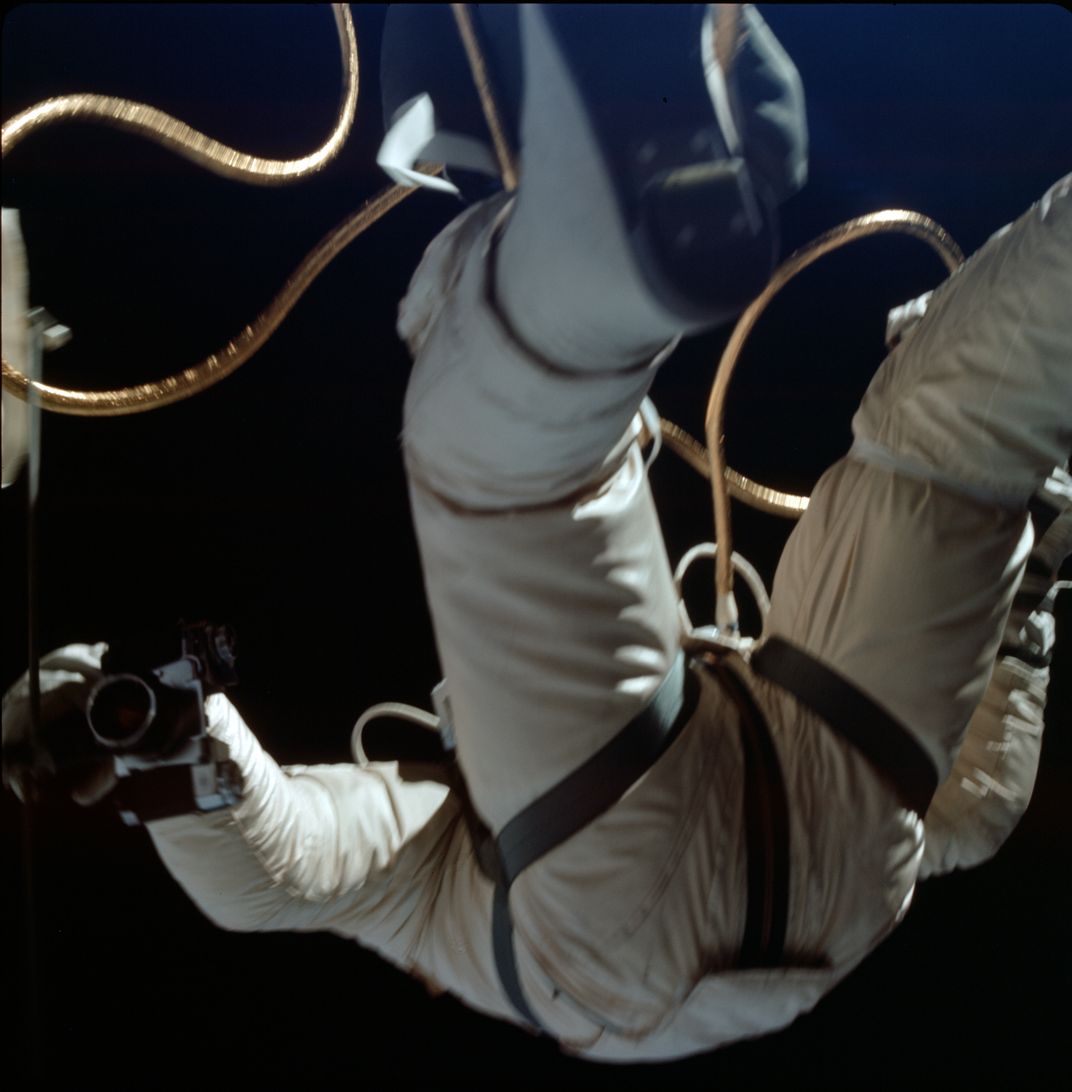
NASA have recently released several photos from their archives, taken during the flights of Gemini, the often overlooked tech testing phase that took place between the Mercury and the Apollo space program.

One haunting image in particular is that of doomed astronaut Ed White wrapped in shadows and looking uncannily like Brad Pitt for some reason (looked nothing like him in general). Anyhow, the rest of the images can be found here.

3 Articles

The Milky Way’s black hole may spring to life in 2013
Astronomers have spotted a cloud of gas with three times the mass of the Earth on a near-collision course with the Milky Way’s central black hole. [full article]

Orson Welles’ Citizen Kane Oscar up for auction
The Oscar Orson Welles won for Citizen Kane 70 years ago will go up for auction online this month, a Los Angeles auction house announced Monday. [full article]

We all lose when ‘healers’ take everything from the sick
There is a legitimate role for a variety of complementary therapies such as yoga, meditation, mindfulness, a balanced diet and moderate exercise. The problem arises when the generic multivitamin tablet from the chemist morphs into weekly intravenous injections costing $1000 a shot. Or when the notion of cleansing the body of toxins is exploited with sham diets and enemas that land patients in the very hospitals they are determined to avoid. [full article]

Blah blah science

Higgs rumours fly as meeting approaches
The latest rumour is that both ATLAS and CMS have evidence that the Higgs mass is about 125 GeV/C2 at confidence levels of 3.5σ and 2.5σ respectively. At 3.5σ, the measurement could be the result of a random fluke just 0.1% of the time whereas at 2.5σ the fluke factor is about 1%. [full article]

Fundamental constants are not constant—or maybe they are, we don’t really know
Now, there is a precedent here. The cosmic microwave background was initially thought to be isotropic—it’s the same where ever you look. However, accurate measurements show that there is a slight difference and the Universe seems to have some sort of global orientation. This might also imply that the fundamental constants could be different depending on which direction we look. [full article]

Smallest habitable world around sun-like star found
The planet, named Kepler-22b, lies 600 light years away around a star of the same type (called G) as the sun. It is about 2.4 times as wide as Earth and orbits its star every 290 days, right in the middle of its star’s habitable zone, where liquid water can exist on an object’s surface. [full article]

Time lapse of Earth from the ISS

Watch this.

That’s all I’m really wanting to say on this one. I’ve posted some previous time lapse videos, but this one has the unique position to be shot from aboard the International Space Station using a special 4K resolution, low light camera at night and daaaamn the resulting beauty of the spinning Earth is just breathtakingly amazing.

I’d rant on and on about it, but really, just check it out for yourself (be sure to do so in HD):

Isn’t that just incredible? From the familiar sights of coastlines and lakes to the strangely foreign spread of the the city lights, to the wonderfully detailed clouds and thunderstorms; all of them floating and spinning together… hell, I get so lost in the simple beauty of it, I almost forget about the whole aurora part being in there too and that part is really amazing. Those towering red and green lights, floating high above the Earth, with the ‘tiny’ cities below and the stars as a backdrop are all so spectacularly captured in this video, to me, they illustrate a grand scale to the Earth and its relationship to the cosmos that’s really not often seen enough. Or at least, not this simple and beautiful in its execution.
Ariel Walden on Hacking Space

Here is founder of spacehack.org, Ariel Walden, presents a rather interesting talk on the possibilities of a more open source space/science community, taking the exclusivity of the field from governments and placing it into the hands of everyday people, whilst still helping to advance science and exploration.

It’s all very inspiring stuff and I’ve only manage to have a brief poke around the website, but man, I do love the thinking behind all these crowd sourcing projects lately.